
Sweet Spot in Arts Ed Advocacy

Photo of a spotted dalmatian dog with flying birds in the background by Karolina Marsaiko on Unsplash
What do we want? Arts education! When do we want it? NOW!
Advocacy for arts education is about more than the rally-style chants popularized in the 1960s. As advocates, we care about many things, from the specific (student access to instruments) to the grand (all arts for all students). We advocate at our local schools, in school districts, with state legislatures, and the federal government.
Who are these tireless, committed advocates? And how do we work together to effect change?
Types of Advocates
As noted in a previous a previous post on The Value of Multiple Perspectives in Advocacy, "effective advocacy sees the larger system while working within a local context. The three perspectives are “practitioner advocate,” “field-builder advocate,” and “policy advocate.”” (Schell, 2022)
Practitioner Advocate: Teachers, teaching artists, artists, community arts organization board and staff, parents, and administrators would fall within this group. They are doing the everyday work of providing creative learning experiences to youth, directly in the classroom and community and indirectly through parenting, partnerships, and administrative support. They engage with field-builders and policy advocates with their real-life examples of impact and positive change.
Field-builder Advocate: Researchers, funders, corporate citizens, faculty at institutions of higher education, or staffers at organizations such as arts service organizations and professional educator associations are in this group. They engage with practitioner and policy advocates to build understanding and knowledge and to increase capacity in the field.
Policy Advocate: National, state, and local advocacy coalitions are in this category. These are the folks who advance policy agendas and resource allocations in support of the arts and cultural education at the municipal, state or regional and national levels. They educate decision-makers and advocates through public engagement, amplify messages, mobilize constituencies for action, and seek to influence (or even lobby) policymakers. They engage with practitioner and field-builder advocates by learning from the grassroots levels to bring about the changes needed and by informing their peers about the realities of public policy processes. (ibid.)
Sweet Spot: Collective Impact at the Core
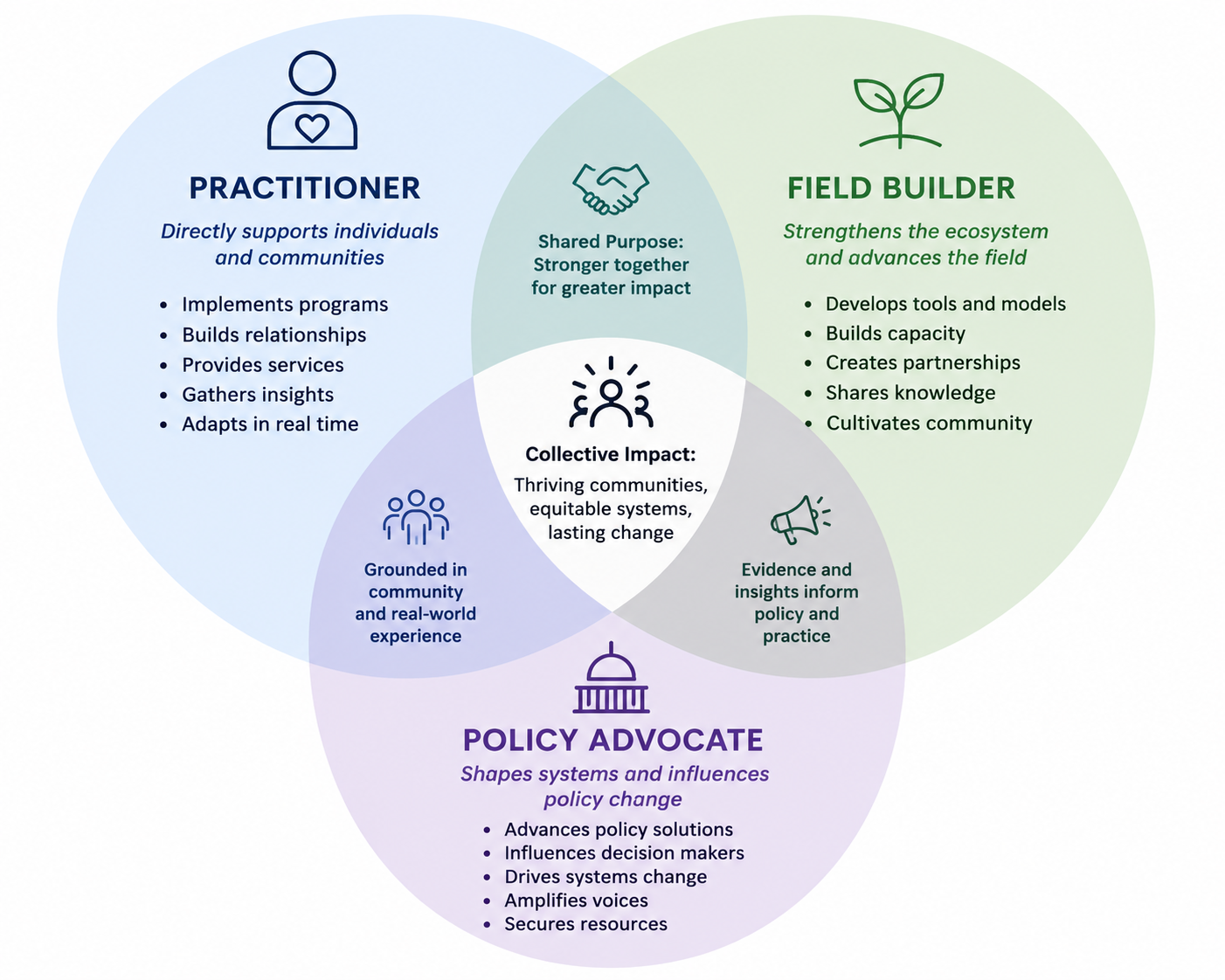
A visual representation shows the three types of advocates and how they work together. The sweet spot in the center of the diagram calls out Collective Impact as the desired result. (Disclaimer: ChatGPT assisted with the graphic design; the concept and ideas are my own.)
A Continuum of Advocacy
When we look to find ourselves in the model, it becomes clear that organizations can be two things at once. They are more than mere hybrids; these organizations work along a continuum of practice that builds infrastructure and agency for the field, often leading to policy change. Here are a few that come to mind:
Americans for the Arts: Policy Advocate → Field-builder
Operates primarily at the national systems/policy level while also providing research, advocacy tools, convening, and infrastructure for the broader arts sector.
Create CA: Field-builder → Policy Advocate
Create CA demonstrates how field building can become policy advocacy: its constituency includes teachers, teaching artists, administrators, parents, youth and community members, while its work includes grassroots organizing, data, field-building at the local level, and policy.
NYC Arts in Education Roundtable: Practitioner → Field-builder
This is an example of practitioners creating infrastructure themselves. The Roundtable began as a community for arts-education leaders to share practice and evolved into a citywide hub for professional development, information, convening, community, and advocacy.
Professional Associations (National Association for Music Education, National Art Education Association, National Dance Education Organization, Educational Theatre Association): Field-builder → Policy Advocate
National arts educator associations combine large practitioner membership with professional learning, infrastructure development, and substantial federal advocacy. Many state level associations feed into national efforts by providing field-building, including professional learning, advocacy, and convening.
Think 360 Arts for Learning in partnership with Colorado Business Committee for the Arts: Practitioner → Field-builder → Policy Advocate
Think 360 Arts combines arts-learning programs and educator/teaching-artist development and field-building. It works in partnership with Colorado Business Committee for the Arts, the state’s premier arts advocacy organization, to advocate policy change for arts education.
Note: There are several other states who also have a partnership/coalition model that reinforces broader arts advocacy with arts education field-building. Examples include Alabama Arts Alliance/Amp Up Arts and Washington State Arts Alliance/Arts for All Coalition/ArtsEd Washington.
Theory to Action
The theoretical framework described above is most useful if it inspires future engagement. Here are some action ideas to prime the pump:
Practitioners
Identify the key organizations that support arts education in your state (e.g., statewide arts/arts ed advocacy nonprofits, professional associations, business committees for the arts).
Join your discipline-specific professional association.
Understand current policies and practices that impact arts education in your state and locality.
Be knowledgeable about advocacy efforts in your state.
Field-builders
Understand current policies and practices that impact arts education in your state and locality.
Connect with broader arts advocacy efforts in your state.
Embed advocacy training in field-building activities.
Provide resources (data and stories) to policy advocates.
Policy Advocates
Be knowledgeable about what is happening at the ground level.
Utilize local knowledge and insights to inform policy agendas.
Build communications systems that integrate voter voice.
Build and maintain data systems that support arts education efforts.
Even if you don’t have a dalmatian or similarly spotted pet, we can reach the sweet spot of collective impact by understanding the larger system and acting from where we are.
Reference:
Schell, Laurie T. (2022) The Value of Multiple Perspectives in Advocacy, Creative Generation Journal, 3:1, 16-24, DOI: 10.51163/creative-gen012