
POV: Arts Ed & Sky Donuts
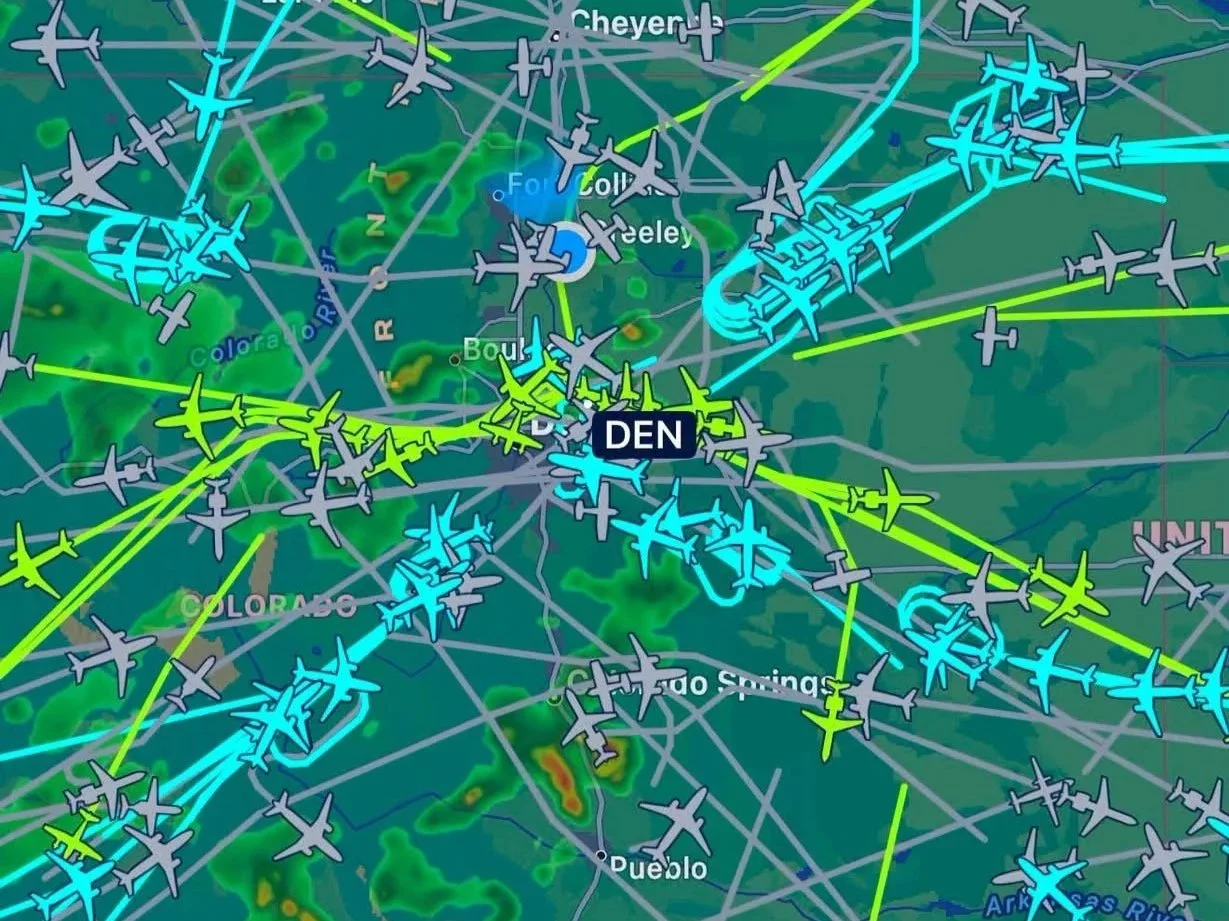
Computer-generated flight tracker from Flight Aware
On a recent flight from Maine to Denver, my fellow passengers and I (along with twenty+ additional planes), were forced into circular holding patterns by thunderstorms, high heat, and wind shear. These so-called sky donuts are useful in keeping flyers safe, that is, until fuel runs low. At which point our flight was diverted to Rapid City, Iowa. Others were sent to regional airports in Colorado Springs, Wichita, Oklahoma City, Casper, and Scottsbluff, Nebraska.
You might wonder what this has to do with arts education? (I had a lot of thinking time somewhere over Iowa.)
Traveling by air toward a desired destination and being diverted due to external (or internal) events is an apt metaphor for the arts. Looking at arts education over the arc of the last 50 years, familiar patterns emerge— forward progress, intermittent circling, and diversionary threats.
A Look Back
Arts education has been on a mostly upward trajectory since the 1970s through the collective efforts of dedicated policymakers and advocates. Unlike reading and math, the arts are not universally available in American public schools. The arts education ecosystem, including a vast network of educators, policymakers, artists, researchers, funders, parents, and community partners, have made gains in advancing arts learning in public schools through activism, data/research, storytelling, and policy advancement.
Sky Donuts
Circular holding patterns mark the circuitous (and continuous) nature of arts ed advocacy. Sky donuts can also be viewed as fallow periods in between campaigns, periods of rest and re-grouping, when the destination is in sight and signs point to go. In 2015, during the period immediately following the passage of Every Student Succeeds Act (ESSA), we celebrated the inclusion of music and arts as central to a well-rounded education. Of course, there was work to be done to ensure states and school districts upheld the intent of the law—circling back to guarantee implementation. With a justified sense of relief, we believed we had done the hard part and arrived at our destination. Not so fast. Five short years later we found ourselves flung out of the flight path to unplanned diversions during the COVID years.
Diversion Due to External Factors
Challenges have long marked the path of progress for arts education. California's Prop 13 (1978) limited property taxes, affecting funding for education—including the arts—and sparked similar tax cuts nationwide. The 2001 No Child Left Behind Act mandated high-stakes testing, narrowing curricula and restricting arts access. From 2020 - 2024, the COVID pandemic led to learning loss, declining mental health, and lower enrollment, further reducing arts education access.
In 2026 we battle egregious policy monsters with budget and program cuts, peril to constitutional rights, book bans, tariffs on trumpets, and threats to access to higher education. All undermining the bedrock of educational purpose and making it increasingly difficult to maintain forward momentum.
Internal Diversions
As humans, we tend to “go with our gut,” letting our emotions rule over reason, leading to bias if left unexamined. Just as we must acknowledge our own unconscious bias about race, class, sex, gender, age, and ethnicity, we must also be careful about the bias of exceptionalism.
Arts and arts education are often segregated within schools and communities. Artists often feel isolated or misunderstood. In education settings, arts classes are often called “specials” and arts educators “specialists.” All of which may lead inadvertently to an attitude of exceptionalism or specialness.
Ironically, decades of making the case for the unique contributions of the arts may have a side effect of separating the arts from the larger community, making it more difficult to be viewed as part of the whole. Further, artistic disciplines have at times become competitive with one another in times of scarcity, resulting in in-fighting and divisiveness.
Landing the Plane
After hours-long uncomfortable delays and diversion, my plane did land safely at Denver International Airport. Landings for arts education often mark way stations along a longer route rather than achieving a final destination. (Think of it as connecting flights, to further indulge a tortured metaphor.) Arts ed advocacy is a long game. We are fortunate to have national organizations lead the charge on the federal level, with good opportunities for engagement. For immediate impact, my money is on state and local advocacy efforts that speak to local issues and bring local solutions. Every district is unique in its geography, demographics, community context, and leadership. As is said of private philanthropy, “If you’ve seen one foundation, then you’ve seen one foundation.” So, too, with school districts.
We often joke in arts ed advocacy that we’re building the plane as we’re flying it. Our field meets the call for creativity, improvisation, and courage on a regular basis. This is one of those moments that calls for clear-eyed and strategic action for local advocates. In these fraught times, I encourage you to find like-minded allies and start flying the plane.
Before you take off, a short check list:
What is the desired outcome?
How will advocacy strategy and tactics align with outcomes?
What do you know? (Data and research)
What is missing in your understanding of the issue?
What is the key message?
Who should be involved?
How is the larger community involved?
Who are the decisionmakers/targeted audience?
What are the costs?
Who will pilot the advocacy effort?
What does accountability and success look like?
Safe, productive travels to us all.