
Art and Awe
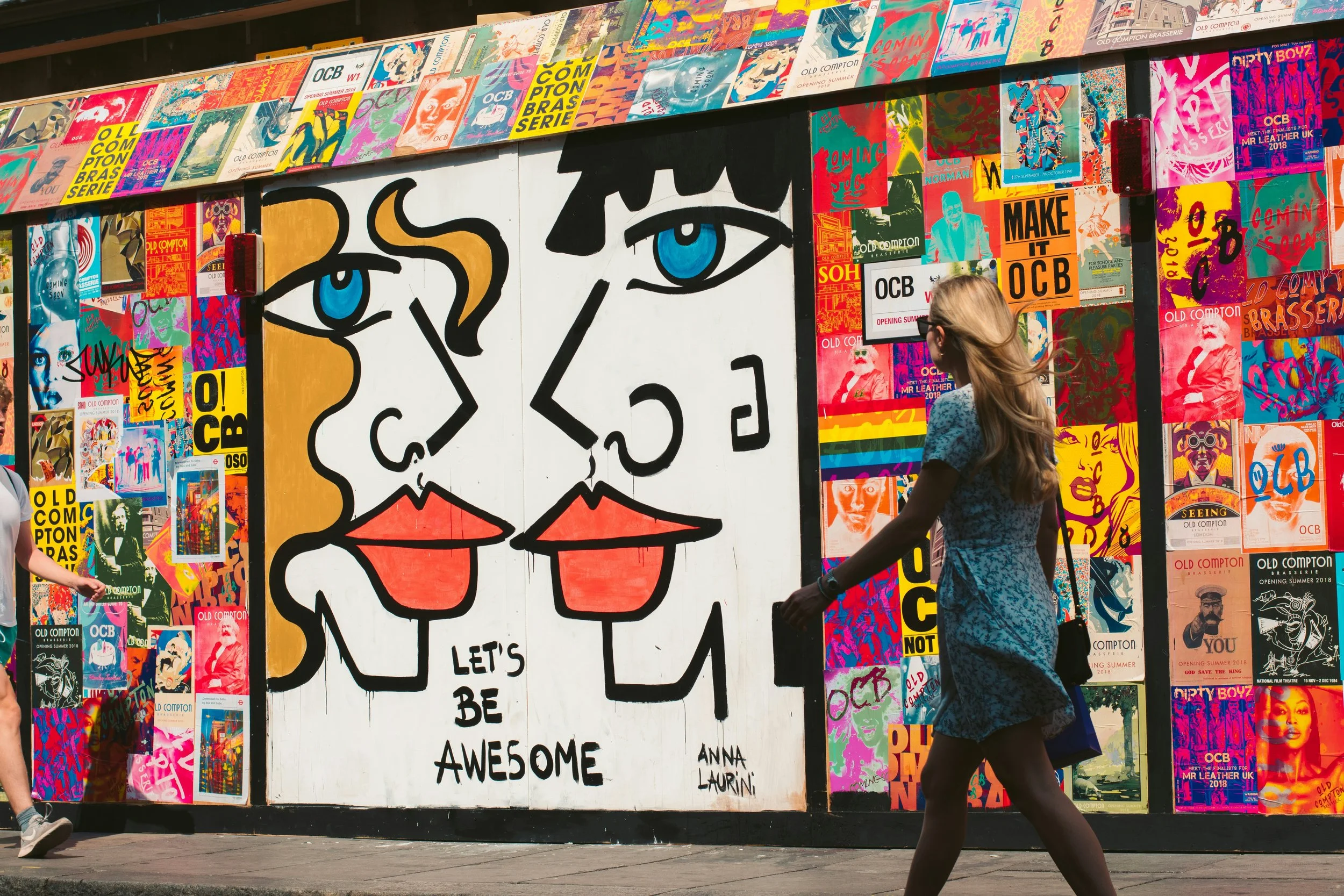
Street art mural photo by Mark Hayward on Unsplash
Last summer I found myself in Calgary, Alberta, Canada for a brief period. With no agenda in mind, I set out to walk the downtown area. Turning a corner I came upon Wonderland, a large wire mesh head sculpture by Jaume Plensa. I had seen photos, of course, but seeing the sculpture by chance, without anticipation or study, took my breath away. It was a moment of wonder, of feeling small in a vastness of possibilities. The sheer size of it, the design and engineering, the changing perspective seen with each step, the interior/exterior metaphor, the reflection in nearby buildings, the reactions of others. In short, it was awesome.
Some will remember when the term “awesome” was ubiquitous. California 1960’s surfing slang meaning “great” or “impressive”, the word became popularized in the 1980’s through Hollywood and youth culture. However, the origins of the word date back to the 1600’s, meaning “to inspire awe” or being in the presence of something vast that transcends your current understanding of the world, a definition that sits on a distant shore from its watered-down modern-day usage.
Art Inspires Awe
Think about the last time you heard Mahler’s 5th, saw a performance of Romeo & Juliet (play or ballet), visited a Frank Gehry building, or viewed the works of Pissarro/Monet/VanGogh/Picasso up close. How did those experiences make you feel? Did you notice a before/after change in affect? Do you feel a sense of wonder in gazing at great works of art and architecture and in experiencing the ephemeral qualities of the performing arts? And what about the experience of creating art, making music, or dancing in community with others? Does that give you the same sense of wonder and well-being?
In our quest to prove value for the arts in education, we overlook the awe factor that arts learning can inspire. In linking arts learning to academic outcomes, higher test scores, or workforce readiness, we forget about awe.
The Science of Awe
Researchers are paying attention to awe as a distinct emotion. In Maria Monroy and Dacher Keltner’s article, Awe as a Pathway to Mental and Physical Health, the authors approach a “scientific study of awe, an emotion often considered ineffable and beyond measurement.”
Not only is awe a distinct emotion that can be measured, it is also proving a benefit to mental and physical health. According to Monroy and Keltner, awe works by… “engag[ing] five processes—shifts in neurophysiology, a diminished focus on the self, increased prosocial relationality, greater social integration, and a heightened sense of meaning—that benefit well-being.”
In Dacher Keltner’s book Awe: The New Science of Everyday Wonder and How It Can Transform Your Life, the author mentions eight sources of awe: moral beauty, collective effervescence, nature, music, spirituality and religion, life and death, epiphany, and visual art.
Awe vs. Joy
Joy is generally signaled by a smile and typically the result of a positive event that fits within our understanding of happiness. The emotion of awe is usually expressed by raised eyebrows, widened eyes, a dropped jaw, and a sharp inhalation. A more complex emotion than joy, awe is the response to encountering vast mysteries that are beyond our typical world view. In my experience, it is like zooming way out to the outer reaches of understanding. On seeing the Wonderland sculpture described above, I felt a connection to the artist and the mysteries of creativity, and to the past, present, future of humanity. A bit woo-woo for some perhaps. But science tells me it’s a real thing. (And no, I’m not on mushrooms.)
Teaching Awe
The words “awe” and “education” seem at odds. When thinking about our current system of public education, the term awe (or even awesome) does not come to mind. We think about rules set out by the authorities, test scores, diminishing budgets, and prescribed curriculum. If we believe that awe is a unique and beneficial component of a healthy life, perhaps we should take a different approach. Perhaps we should look more closely at the emerging model of arts Rx or social prescription, when health professionals recommend creative, cultural, or nature-based activities as a pathway to health rather than relying only on medications. I posit that the same benefits will hold true if we build in more opportunities for awe in our education system.
Teachers are awesome. Full stop.
When I visit classrooms that are rich in arts learning, I am awe-inspired to witness: 1) the magic of great teaching; and 2) students’ discovery process as a result. Yes, there is skill and technique in making art. There is also freedom to explore, to create, to wonder and wander. Though awe may not be on the lesson plan, the underlying tenants of the national core arts standards-- creating, performing, responding, and connecting—are embedded in every learning activity. And are also aligned with conditions that would be conducive to awe. Of particular significance is the “connecting” piece. Activities that enable connection with others, thus reducing ego and self-centeredness, are consistent with feelings of awe. Research says the capacity for wonder and awe begins in the pre-teen years. (Very young children are busy figuring out a sense of self, never mind the mysteries of the universe.) What if teachers ended every lesson in grades 5 through 12 by asking, “How did you experience wonder today?” Every day is an opportunity for students to imagine and to feel wonder.
Every day is an opportunity for awe. Let’s make it happen.
References
Keltner, D. (2024). Awe: The new science of everyday wonder and how it can transform your life. Penguin.
Monroy, M., & Keltner, D. (2022). Awe as a Pathway to Mental and Physical Health. Perspectives on Psychological Science, 18(2), 309-320. https://doi.org/10.1177/17456916221094856 (Original work published 2023)
Reese, H. (2003, January 3). How a Bit of Awe Can Improve Your Health. The New York Times. https://www.nytimes.com/2023/01/03/well/live/awe-wonder-dacher-keltner.html#:~:text=So%20what%20is%20it%20biologically,you%20encounter%20the%20Dalai%20Lama.
Vedantam, S. (2025, December 22). Hidden Brain: The Reset Button. https://podcasts.apple.com/us/podcast/hidden-brain/id1028908750?i=1000742369672